
Psychotherapy: nowadays, there are a hundred different kinds. CGT, ACT, EMDR, schema therapy, IFS, MBT, DBT, and every year new abbreviations are added, nicely wrapped up in some training, and labelled with a price tag. If you’re looking for help, it seems like you can choose from a rack full of boxes with different labels. But what exactly is in those boxes? And does the content really differ as much as the labels suggest?
Everyone’s a Winner and everyone Wins a Prize
For 80 years, research has shown that it doesn’t. Put two kinds of therapy next to each other, and you often find that they both work equally well. In literature this is called the dodo bird verdict, named after the dodo from Alice in Wonderland, who, after a race declares that everyone is a winner, and everyone gets a prize. What can make a difference, is the healthcare professional. Some of them get better results than their colleagues, and that difference does not stem from their title, or their experience.
So what does work? Research on common factors keeps showing the same thing. Healthcare professionals who are really there for you and don’t judge you. Someone who thinks with you, rather than about you. Trust. Shared ideas about what you are looking for. Nothing spectacular, but very effective.
Proven better, or proven easier to research?
This isn’t easy for an industry that sells itself on technique. It is conflicting with the word the whole mental healthcare industry revolves around: evidence-based. This term has been nicked by the insurance logics. What was paid for, needed to be proven. And proof meant: a protocol, a manual, a group of people with the same DSM-diagnosis, and at the end a questionnaire about symptoms.
Just therapies with a manual fit into that format. That’s why the majority of the trials is about CGT and varieties thereof. And that’s why many people now think that CGT has been proven better. But that just isn’t right. It has been proven to be easier to research, and that is not the same thing.
And there is another problem with the questionnaire at the end. When you ask people why they have sought therapy, they seldom answer “to reduce my symptoms”. They’ll say “to understand myself better, to be kinder to myself, to get a different point of view on my condition”, or “to be able to form stronger relationships. We don’t measure what people want to get out of their therapy, and then draw conclusions about what works.
How Your Brain Creates Your Experience of Reality
And that’s the interesting part. Because recently, a statement has been released that makes the conflict between the different movements obsolete, and comes as a bit of a surprise: the neuroscience of the predicting brain.
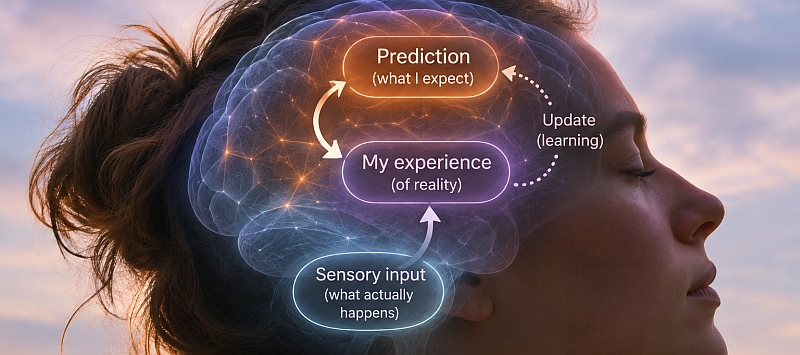
The idea is this: your eyes and ears don’t show you what is happening around you. Your brain is constantly building a model of the world and uses that to predict what is going to happen in the near future. But you don’t experience that prediction as a prediction, you experience it like it is the truth. Only when the sensory perception conflicts with the prediction, your brain has to choose: do I believe myself? Or do I believe what I am observing? More often the observed information wins, and the model adjusts itself. That’s how you learn.
Except for when the model consists of experiences that have something to do with surviving. Because then, the prediction wins, even if it is not correct any more. Imagine I am walking through town and I someone passes me without saying hello. And I think, see, nobody loves me. Even though the person was just not wearing his glasses, and therefore couldn’t see me. That is not a thought that is created by a brain that doesn’t function, it’s a prediction based on old material. Early memories carry the most weight, because as a small child you were depending on others and rejection could be life threatening. Those memories are stored in a place that your conscious cannot reach.
What Predictive Processing Means for Psychosis
For everyone who lives with sensitivity to psychosis, this is not a hypothetical situation. And that is the essence. Meaning doesn’t come from external influences. It is being created.
If you are under pressure, not sleeping well, or have been in a situation where you had to have your guard up for years, your brain will start leaning heavier on it’s own prediction. The look of a man on the tram suddenly has a meaning, they are talking about you on the radio. And as long as your brain is not getting corrected, the model keeps getting confirmed. That is the opposite of a defect. It’s a normal mechanism that has gotten out of control, similar to how high blood pressure can occur in a normal blood vessel.
Why Safety and New Experiences Matter in Recovery
What kind of help does that produce? Two things, and neither of them are printed on a certificate.
The first one is safety. A brain that feels threatened, will cling tightly to its own predictions. Fear makes learning impossible. That’s the reason the relationship is so important, that predictability and availability are so important, and that social holding is important. For someone to hold you, is not merely a condition under which you do the real work. It is the real work.
The second one is precision. Safety alone doesn’t change anything. With just safety everything stays as it just, just a little more pleasant. There have to be experiences that get through to those predictions that are stuck in the brain, so the brain can notice these mistakes and adjust its model. Someone who doesn’t leave you at a time you expect everyone to leave, a group in which you can talk about the voices you’ve been hearing and nobody judges you, a job in which you notice you can do it, despite what you thought. We call this recontextualising we call this: the same experience, but a different place in your story.
And this doesn’t always happen in a doctor’s office. They are often the random moments that will make your model falter: a neighbour asking you something mundane at a moment your world starts looking suspicious, a colleague talking to you, or someone who rings you without a specific reason. No protocol, no sessions, no declaration.
Psychotherapy: Where Recovery Happens Beyond it
That’s what it’s really about. If safety and precision are the necessary ingredients, it’s not about what type of therapy someone gets, but whether they have the mental space for the two. And then it’s pretty crazy we have thought of placing these patients with a professional who has a long waiting list. Recovery academies, peer support, support groups, a place of work, a neighbour, a friend: those are the places where people can find safety, stability, and correction all at one.
Work to be done
On two fronts. For healthcare professionals: stop defending your form of therapy and invest in what you share with all other forms. For the system: fund the places where people hold each other, not the sessions that identify symptoms.
And for you, if you’re searching, don’t let your first question be about what form of therapy someone uses. Ask yourself whether you think this person can help you, takes you seriously, and won’t walk away when things get complicated. That predicts more than some words on a label.

Prof. dr. Jim van Os, Chair Division Neuroscience, Utrecht University Medical Centre. Jim works at the interface of ‘hard’ brain science, health services research, art and subjective experiences of people with ‘lived experience’ in mental healthcare.
Jim has been appearing on the Thomson-Reuter Web of Science list of ‘most influential scientific minds of our time’ since 2014. In 2014 he published his book ‘Beyond DSM-5‘, and in 2016 the book ‘Good Mental Health Care’. In 2026 he published 'Wat psychisch lijden is'.
Want to read more?
Blogs by Jim van Os can be read here
Did you know that PsychosisNet regularly posts new content?
Online tests
Compare antidepressants tool
Compare antipsychotics tool
Podcasts
Books



Comments: