
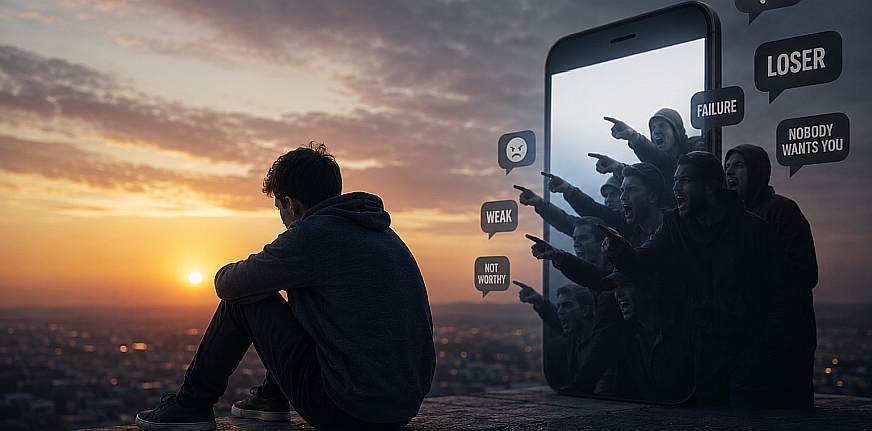
Social rejection and psychosis are closely related: someone who’s consistently excluded, has a greater risk of mental disruption. The manosphere can seem like a source of understanding, but it often actually adds to their vulnerability. What does this mean for the psyche and how damaging is this ideology they find there?
Social Rejection and Psychosis: What does social defeat do to your psyche?
In the mental health sector there is a mechanism we know all too well: social defeat. The term sounds technical, but the concept is simple. If you constantly feel like you don’t belong anywhere, that you’re being rejected, that you’re at the bottom of the social ladder without hope of improving, something changes in your psyche, and in your brain. The systems get sensitised. You start looking for meaning of situations that you really shouldn’t waste your time on. And this causes a higher chance of sensitivity to psychosis, of experiencing the world in a way that is farther and farther removed from the shared reality.
It sounds abstract, but is actually happening to many young men these days.
Tolerance of homosexuality under pressure
25 years after the first gay marriage in the Netherlands, the acceptance of homosexuality is under pressure. Veterans of the homosexual emancipation movement look back gloomily: the word ‘gay’ is still often used as a derogative term in sports, schools, and on social media. In Amsterdam, less than half of the people in the second and fourth year of secondary school finds it normal that two people of the same sex fall in love with each other. That is not an opinion on the edge of society, that is centrally.
Experts are looking for causes. Femke Halsema, mayor of Amsterdam, pointed out the increased influence of popular bloggers like Andrew Tate, although researchers claim that there’s no direct link between the manosphere and the decrease of tolerance of homosexuals. But the connection is plausible enough to take seriously.
What is the manosphere and what does it entail?
So what actually is the manosphere? It’s not an organisation and it doesn’t have a leader. It’s a loosely connected online subculture of men who are focused on manliness, relationships, and position of men in society. Within it there are multiple movements.
The red-pill movement; ‘taking the red pill’ refers to a realisation of the belief that society is biased against men and that the traditional gender dynamics have been subverted by feminism – women should by nature strive for the best suitable partner, and in a traditional society they would benefit from that.MGTOW (Men Going Their Own Way) is an anti-feminist movement of men who consciously avoid women to focus on sovereignty.
Incels are men who have no romantic or sexual relationships, and are bitter about this.
PUA (Pick Up Artists) communities share techniques to pick up women. And on the extreme right you’ve got men who stick up for their male interests and link that to an anti-feminist and sometimes racist world view. Whilst women often see messages about gender equality on social media, men are more and more exposed to female-unfriendly ideas.
Pain as an entrance, ideology as a trap
Here, the link to sensitivity to psychosis becomes relevant.
The men who are the closest connected to the manosphere are often not the tough and confident men they seem to be online. They are men with real pain, loneliness, social anxiety, a feeling of not belonging, and constant rejection in real life. This is exactly the profile that fits social defeat. And the manosphere offers them something alluring; an explanation. The problem isn’t you, it’s the system. It’s women, it’s feminism, it’s gays, and society. That explanation feels like a relief, but at the same time it blocks the only thing that really helps: real social connection, and professional help if that’s necessary.
When online confirmation feeds pre-psychotic thinking
There is more. The common thread running through many of the manosphere-ideologies has a striking paranoia-structure. Women cheat, society is corrupt, and only insiders see the real truth. And that is a thoughts-system that fits seamlessly into low-grade, suspicious thinking. In ‘normal’ social connections these kinds of thoughts are corrected by the reality around you. But online communities work differently. They reinforce and reconfirm. The algorithms offer ever more extreme variants. So your pre-psychotic thoughts aren’t corrected, but strengthened.
Homosexuality is a reoccurring theme in the extreme ideas of the manosphere. It fits into a world view in which different sexes have different roles, and deviation of those roles is seen as a threat. Men who reject homosexuals or bisexuals, often don’t do this merely on religious grounds, but also because being gay disrupts their image of masculinity. The manosphere gives that direction a pseudorational character.
The result is an uncomfortable paradox. The men who are most vulnerable – lonely, socially rejected – seek connection with communities that worsen their vulnerability and spread intolerance to others who are just as vulnerable.
What can we do?
The manosphere distances itself more and more from the conventional way of thinking. But that doesn’t help the young man who’s in his room at eleven at night, looking at content on how women took advantage of him, and society failed him. That man doesn’t deserve to be judged, he deserves a conversation. Schools, youth workers, GP’s, mental healthcare professionals and psychiatrists need to know that this is happening, and what it looks like. Early, social isolation and online radicalisation are risk factors of sensitivity to psychosis, and now we have a generation of young men in which both risk factors come together.
At the same time, we mustn’t be naive. The ideology itself is harmful. It spreads intolerance, damages men in the process, and has harmful consequences for members of the LGBTQ+ community. To stand up against that toxic concept is not a political choice, it’s a matter of common sense.

Prof. dr. Jim van Os, Chair Division Neuroscience, Utrecht University Medical Centre. Jim is also Visiting Professor of Psychiatric Epidemiology at the Institute of Psychiatry in London. Jim works at the interface of ‘hard’ brain science, health services research, art and subjective experiences of people with ‘lived experience’ in mental healthcare.
Jim has been appearing on the Thomson-Reuter Web of Science list of ‘most influential scientific minds of our time’ since 2014. In 2014 he published his book ‘Beyond DSM-5‘, and in 2016 the book ‘Good Mental Health Care’.
Want to read more?
Did you know that PsychosisNet regularly posts new content?



Comments: