
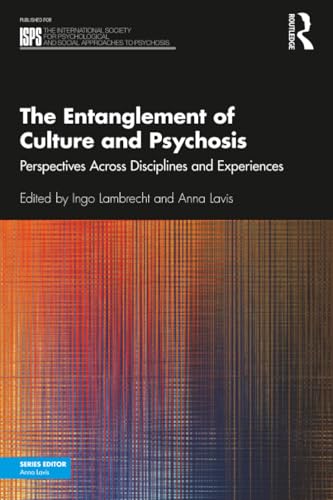
The way people experience, understand and treat psychosis differs from place to place and from time to time. The Entanglement of Culture and Psychosis brings together authors from many countries and disciplines to show how deep that goes.
The editors are Ingo Lambrecht, a consultant clinical psychologist in Auckland, New Zealand, and Anna Lavis, a medical anthropologist at the University of Birmingham. The book does not treat culture or psychosis as fixed things. The chapters trace how personal experiences of illness and recovery, forms of treatment and diagnostic categories are all shaped by culture.
From heavy metal to the Maasai
The 19 chapters range widely. There are contributions on hallucinations and culture, on the meeting of heavy metal music culture and psychosis, on psychotic experience in the Arab world, on mysticism and madness, and on self-determination from a Maori perspective. Other chapters deal with racism and psychosis, with cultural ruptures in Ireland across generations, with distressing voices among Maasai women in Tanzania, and with possession in psychiatric hospitals in rural India. One chapter examines the othering culture of Western biological psychiatry. Another asks what is in a word: schizophrenia or psychosis, vulnerability or sensitivity, recovery or discovery.
Why it fits PsychosisNet
PsychosisNet sees psychosis as an experience that gets its meaning in a context: a life story, a family, a society. This book widens that context to culture, and it treats Western psychiatry as one culture among others. It appears in the book series of ISPS, the International Society for Psychological and Social Approaches to Psychosis. It is an academic book, for practitioners, students and people with lived experience who want to read in depth.
Book details: Routledge, 2026, 286 pages.
This book presentation is based on information from the publisher and on published reviews.

Prof. dr. Jim van Os, Chair Division Neuroscience, Utrecht University Medical Centre. Jim works at the interface of ‘hard’ brain science, health services research, art and subjective experiences of people with ‘lived experience’ in mental healthcare.
Jim has been appearing on the Thomson-Reuter Web of Science list of ‘most influential scientific minds of our time’ since 2014. In 2014 he published his book ‘Beyond DSM-5‘, and in 2016 the book ‘Good Mental Health Care’. In 2026 he published 'Wat psychisch lijden is'.
Want to read more?
Blogs by Jim van Os can be read here
Did you know that PsychosisNet regularly posts new content?
Online tests
Compare antidepressants tool
Compare antipsychotics tool
Podcasts
Books


Comments: